Friday, May 12, 2006

8000 skulls: Phnom Penh, Cambodia (2)

8000 skulls: Phnom Penh, Cambodia (2)

Sickened deep into the gut by the horrors of Tuol Suay Prey High School/S-21 security prison, Andy and I took a motorbike taxi (3 men squeezed on one 100cc motorbike and 1 helmet between us - the norm) through bustling Phnom Penh. We were following the route taken by the S-21 survivors to their final resting place: Cheoung Ek Extermination Camp.

Just beyond the entrance to the Killing Fields, the first tourist 'attraction' is a memorial stupa that whacks the tourist with a direct hit the scale of the brutality that Pol Pot inflicted onto his own people, at this site. From a distance, the memorial resembles some modern art piece: a 15 or so metre high tower of clear perspex and white brick with a roof of golden spikes. But on reaching the entrance step one sees that it houses the remains of those who died here. The 16 shelves are loaded with human skulls, sorted by age and gender. At shoulder level directly beyond the entrance is the 'juvenile females age 15 to 20' group. The front 2 skulls stared back vacantly at me, showing off their lethal bullet and bludgeon marks, as the silent echo of their last scream resonated in my ears.
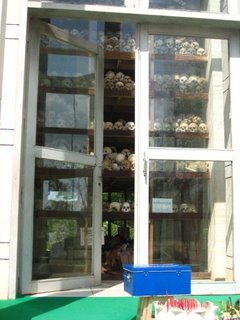


The memorial to the Cheoung Ek victims – bottom 5 of 16 shelves
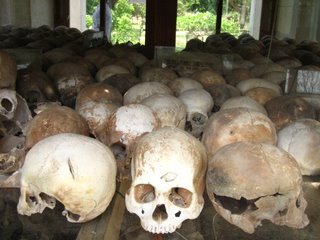
Some of the 'juvenile females age 15 to 20'
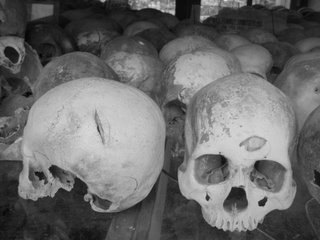
Nauseated, I dragged my feet along to the tourist information boards, informing that from the 88 of 129 mass graves unearthed here, 8985 corpses have been recovered. A long message titled 'The Most Tragic' attempts to describe what happened at this giant tomb and across Cambodia under Pol Pot (Kampuchea, Campuchea):

"....we imagine that we are hearing the grevious voice of the victims who were beaten with canes, bamboo stumps or heads of hoes. Who were stabbed with knives or swords we seem to be looking at the horrifying scenes and the panic on stricken faces of the people who were dying of starvation, forced labour or torture without mercy on their skinny body. They died without giving their last words to their kith and kin.... How bitter they were when seeing their beloved children, wives, husbands, brothers or sisters were seized and tightly bound before being taken to the mass grave! While they were waiting for their turn to come and share the same tragic lot.

The method of massacre which the clique of Pol Pot criminals carried out upon the innocent people of Kampuchea cannot be described fully and clearly in words, because the invention of this killing method was strangely cruel so it is difficult for us to determine who they are for: they have human form but their hearts are demon's hearts, they have got the Khmer face but their activities are reactionary. They wanted to transform Campuchean people into a group of persons without reason, or a group who knew or understood nothing, who always bent their heads to carry out Ankar's orders blindly. They had educated and transformed young people and the adolescents whose hearts were pure, gentle and modest into odious executioners who dared to kill the innocent and even their own parents, relatives or friends.

They had burnt the market place, abolished monetary system, eliminated books of rules and principles of national culture, destroyed schools, hospitals, pagodas and beautiful monuments such as Angkor Wat temple. They were trying hard to get rid of our Khmer characters and transform the soil and waters of Kampuchea into a sea of blood and tears, deprived of cultural infra-structure, civilisation and national character. [Here] Became a desert of great destruction that drove our society back to the Stone Age."

And beyond the billboards, the rest of Cheoung Ek's 'sights' are just a handful of the excavated mass grave pits. The victims were made to dig large pits and stand inside as they were either shot or buried alive (1). They're about bus-sized, 2 metre deep indentations, fenced off, sheltered and signposted with details like:

Grave 5. Mass grave of more than 100 women and children

Grave 6. 450 victims

Grave 7:
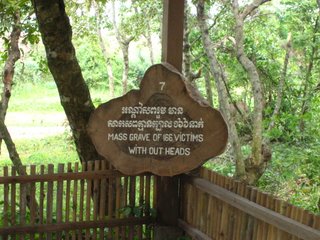
It was eerily peaceful strolling around on hard earth punctured by up-projecting human bones and faded fragments of clothing, still attached to their owners lying inches below my feet. By the unexcavated Chinese mass grave is the site where Khmer Rouge soldiers practised clay pigeon shooting using babies that were alive when they were tossed up into the air. Birds chirped in the tree that still displays marks where ropes once held child victims to its trunk to be flogged. Around me, young lads playfully chased a chicken. Tinny karaoke music and adolescent singing drifted on the faint breeze. Chocolate-skinned kids dive-bombed and swam in a swimming pool sized rectangular pit holding a muddy pond (that may have been a giant mass grave?!), while on the other side of the embankment a woman toiled in her rice field and white cows munched grass. The swimming kids waved and sought my attention by following my head turn with, "Hello hello mister" and 1/2 submerged, wobbly headstands. However I felt too drained and depressed to have the standard 20 times a day, "What's your name? Where you from?" Q & A session with these ragged urchins.
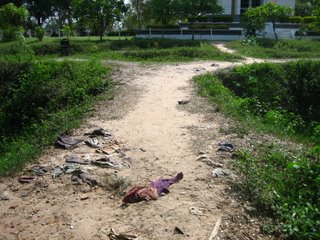
Human rags and bones in the earth between excavated mass graves

8985 corpses of ordinary Cambodians and foreigners have so far been dug out from the earth of Cheoung Ek extermination camp. Only 7 people sent here by the Khmer Rouge exited alive. The Khmer Rouge were responsible for the deaths of up to 2 million people by the most atrocious methods. Only 2 members of the Khmer Rouge are being held for their crimes (1 in a coma) and it's taken until this month (July '06) for officials to be sworn in for long-awaited UN-backed genocide trials! It's looking highly unlikely that any Khmer Rouge murderer will ever be prosecuted for what they committed here:

http://news.bbc.co.uk/2/hi/asia-pacific/5182534.stm
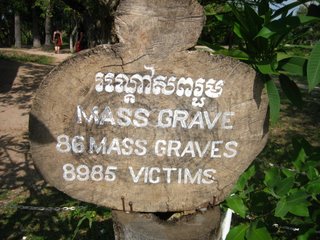
Staring at these horrific death count statistics, I continue to wonder what could drive a human, often teenage, to: bury others alive; murder without any guilt, mercy or conscience; feed innocent people to crocodiles; butcher and torture their own nationals and even their own parents and siblings. Is this 'ability' learned, genetic, innate, conducted out of fear, or simply acted out to stay on the preferred end of the gun barrel/sword handle? I don't have any answers; I'm just a geologist.

In these last 2 mails I have only scraped the surface of the treatment of the Cambodian people by the Khmer Rouge. For more details do read:
(1). http://www.history.ucsb.edu/faculty/marcuse/classes/33d/projects/genocides/cambodia/CambodiaHistoryLavinia.htm

In my 6 days in Cambodia I could only focus on the big tourist sites, which unfortunately were centred on ruined temples, landmines, torture and genocide. The snapshots of everyday life I saw were also filled with people building their lives and country with much vigour, and joy at the simple things in life. Definitely worth a visit.


Laos next for some much deserved cheer..........

Thursday, May 11, 2006

School of torture: Phnom Penh, Cambodia (1)

I went to Cambodia's capital, Phnom Penh, specifically for the tourist sites S-21 and Cheounk Ek, to see and write about the atrocities committed there during our lifetimes.

The bus trip into Phnom Penh was about average quality for SE Asia. The bus had air con and did about 40 miles in an hour on a road that was tarmac (excellent!). On the down side, the karaoke started at 8am and the following entertainment was even worse. As in most SE Asian movies or music videos, the 'comic' star was a pathetic excuse of a male, acting like an ape in the company of the dollybird and like a complete dickhead at all other times: unable to do simple tasks and screeching about with the voice of an overly camp fairy holding his nose. And at full volume! And I'm so disheartend to see this alive and well on the streets.

Anyway, I wasn't coming to Phnom Penh to be baffled by the local male psyche. Rather, there are 2 major symbols of the Cambodian genocide years under Pol Pot to see. Led by dictator Pol Pot, the communist Khmer Rouge regime undertook a radical experiment that attempted to turn Cambodia into a classless society by depopulating cities and forcing the urban population into agricultural communes. Money, private property, education and even religion were outlawed as all Cambodians were rehoused in concentration camps as farmers. Many were overworked: toiling for almost 15 hours a day non-stop with only one meal. Work lasted from 6am to 9pm, after which they had to listen to classes on the greatness of the Khmer Rouge. Men, women and families were separated and contact with each other was prohibited. One could even be killed for trying to find one's wife or child. The regime reigned from 1975 to 1979 and its policies were responsible for the deaths of up to two million people from starvation, disease, overwork, and execution (1 and 2).

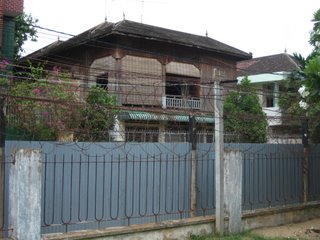
Before seeing some remnants of this regime's toll, Andy and I took a 'tuk tuk' (motorbike-pulled covered trailer) to meet friend 'Hawaii' in the Bodey Tree restaurant for brunch. Despite sitting amongst the blooming gardens and wooden panelling of this fine French colonial house, with gorgeous Cambodian coffee and melted gorgonzola on toast, it was difficult to avert our eyes from what lay directly opposite:


The view across the lane

After having our fill of luxury food, we slowly crossed the lane to the high double wall topped with several coils of barbed wire: genocide horror site 1. In 1975, Tuol Suay Prey High School was taken over by the Khmer Rouge killing machine and became the S-21 security prison. In S-21, people were detained for such things as having an education to high school level, or wearing spectacles. They were imprisoned and exterminated for being peasants, workers, engineers, teachers, doctors, students, Buddhist monks, ministers, Pol Pot's cadres, soldiers of all ranks, foreigners, and all their wives and children. By early 1977 it was claiming 160 victims per day; these 'lucky' ones were buried on site in mass graves. Most detainees however ended up in the nearby Cheoung Ek Extermination Camp: 'The Killing Fields'.

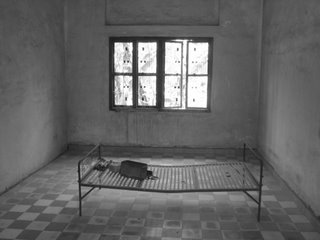
Each of Building 1's classrooms contained only a metal bedframe (no mattress), a bullets can/toilet and a wall-mounted photo of the room as it was found, including the bird-pecked corpse of the ex-government official who died trussed to the bed in each cell:


A classroom/prison cell

Outside in the yard is a billboard listing the rules and regulations that had to be adhered to by the detainees, and the punishments if they weren't:

1. You must answer accordingly to my question - Don't turn them away.

2. Don't try to hide the facts by making pretexts this and that. You are strictly prohibited to contest me.

3. Don't be a fool for you are a chap who dare thwart the revolution.

4. You must answer immediately my questions without wasting time to reflect.

5. Don't tell me either about your immoralities or the essence of the revolution.

6. While getting lashes or electrification you must not cry at all.

7. Do nothing, sit still and wait for my orders. If there is no order, keep quiet.

8. Don't make pretext about Lampuchea Krom in order to hide your secret or traitor.

9. If you don't follow the above rules, you shall get many lashes of electric wire.

10. If you disobey any point of my regulations you shall get either 10 lashes or five shocks of electric discharge.

*Remember, these people were being detained simply for being peasants, workers, engineers, teachers, doctors, students, Buddhist monks, ministers, Pol Pot's cadres, soldiers of all ranks, foreigners, and all their wives and children.

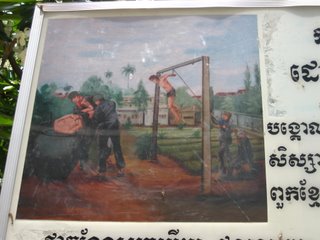
Building 2's balcony corridors were sealed by barbed wire mesh to prevent detainees jumping to an easy death. Below it, the gym frame had been converted to gallows:


The gallows

"A pole with cables attached had been used for the students to conduct their exercise. The Khmer Rouge utilised this place as interrogation room. The interrogators tied both hands of the prisoners to the back by a rope and lifted the prisoners upside down. They did like this until the prisoners lost consciousness. Then they dipped the prisoner's head into a jar of smelly, filthy water, which they normally used as fertiliser for the crops on the terrace outside. By doing so, the victims quickly regain consciousness, and that the interrogators could continued their interrogation."

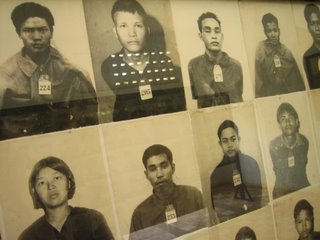
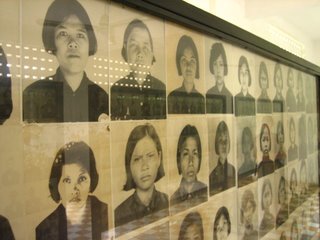
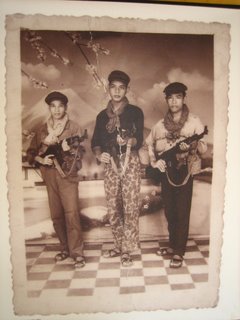
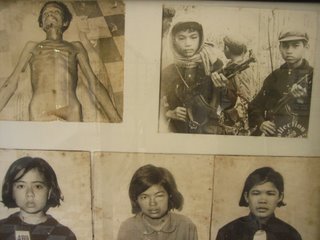
The long rooms inside Building 2 are filled with presentation boards, upon which hundreds of photos of sullen-faced and pained Cambodians are mounted. These males and females aged 8 to 80 were some of the Khmer Rouge soldiers and their victims, the soldiers only differentiated from their prey by not having a number tag around their necks:

Victims

Khmer Rouge soldiers

Classrooms have been converted into galleries that exhibit photos and biographies of village youngsters (CHILDREN!) who'd entered the Khmer Rouge, what atrocities they'd personally committed and how they'd come to an early death at the hands of other Khmer Rouge soldiers.


'noble heroes'!


Child soldiers and their 'work'

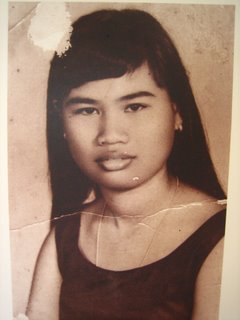
One of the many examples is of Uy Ren, who was born in 1951 and joined the revolution at the age of 19:

"Ren was a simple woman, not so bad. She asked her parents' permission to join the Khmer Rouge because at that time, everyone was joining. It was better than staying in the village and carrying dirt. The female youth teams in our village were asked to carry dirt at Tuol Krasaing and they all disappeared.

Ren was sent to the battlefield near Tonle Mekong to fight. There were only females in her unit and they fought on the front lines. She was a group chief.

Ren first visited home quite a lot before the Khmer Rouge took control of Phnom Penh. She came looking for cows. In July 1977 she came home again to find food, this time in an army lorry. The others with her carried guns but she didn't; she only carried her gun in the battlefield. She stayed one night. She didn't say much.... After that she disappeared.

I kept her picture for the future in case she came back one day.... One person told me she died in the bombing at Srey Royong. Someone else said she was taken to Tuol Sleng [S-21]"

Ren, the "not so bad" girl

Other rooms were divided by brick partitions into torture cells the size of portaloo toilet cabins, containing only a bullet tin for a toilet and a leg-chain floor mount. Another storey was filled with graphic images of torture methods used and photos of people, when alive and dead, who'd succumbed to them. Building 3 contained photos of Khmer Rouge high officials that had been graffittied by Cambodian expletives.


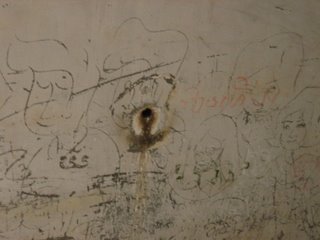
I was too distressed to look at any more of the Khmer Rouge's work, so I looked at the graffiti on corridor walls. Some was drawn at the time the buildings were still Tuol Suay Prey High School: outlines of girls wearing stylish, brimmed bonnets, cars, a maths equation.


Schoolkid art

Other scrawlings were by tourists, and range from the poignant:

"When this was a prison no-one learned.
When this was a school no-one died"

through the ignorant and moronic:

"Jesus is the answer"

"Jesus reigns"

to some of dispicably bad taste, considering the setting:

"This is socialism? Go U.S.A"

"They hate us [U.S.A.] because they're jealous of us"

Of course, the last American opinions had provoked a spiderdiagram of responses by people as horrified as I to see such narrow-minded and disgraceful thoughts actually written. Did these idiots know the Khmer Rouge were armed and financed throughout the 1980's by China and the U.S. (indirectly through Thailand of course) (3)? Graffittied responses included mention of Abu Ghraib (The U.S.'s very own torture camp in Iraq), Thatcher's "You must understand. There are responsible members of Khmer Rouge", and:

"Are we supposed to be jealous of your [U.S.A.]: literacy, poverty, violent death rate, pollution, racism, trash culture, imperialism, ignorance, obesity?"

What a pity pro- and Anti-U.S.A. slanging matches are even being set onto stone in a former torture centre.

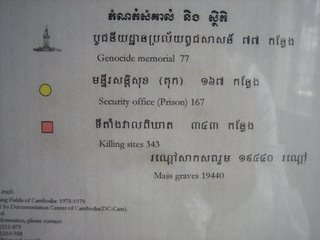
Of course, S-21 wasn't the only security prison of it's kind in Cambodia, as this key of a regional death map shows (Genocide memorial - 77; Security office (Prison) - 167; Killing sites - 343; mass graves - 19440):


How many?


Sickened deep into the gut by the horrors of Tuol Suay Prey High School/S-21 security prison, Andy and I then took a motorbike taxi (3 men squeezed on one 100cc motorbike and 1 helmet between us - the norm) along the route taken by the S-21 survivors, to their final resting place....

(1) http://news.nationalgeographic.com/news/2005/12/1202_051202_cambodia.html

(2)http://www.history.ucsb.edu/faculty/marcuse/classes/33d/projects/genocides/cambodia/CambodiaHistoryLavinia.htmSoutheast

(3) Southeast Asia on a shoestring. Lonely planet, 2004.

The Cambodian landmine museum

Viking Eric and Anna recommended a visit to the Landmine Museum, as a place to see an underground, yet vicious aspect of life's daily struggle for today's rural Cambodians. It is a far more memorable and worthwhile place to see than Angkor.

Lying somewhere behind the Angkor Wat ticket office, it was quite difficult to find the Landmine Museum without signposts; the authorities remove them as they regard the anti-landmine information being displayed there as dangerous. As Andy and I mooched through a poor village on our electric bikes (now there's transport genius! - cycling with a big battery that charges up through the day and gives you a moped ride home) we saw lots of shacks, families with very little possessions and a couple of signs like this:


And then at the end of a dusty track near fields we came across the place. We were greeted by a welcome sign portraying a skull and cross-bones and a mine-maimed child. It wasn't any prettier inside.
Welcome sign

Probably better titled 'Landmine Awareness Museum', we were greeted at the entrance by a teenager on crutches to compensate for one missing leg, and a gaggle of scruffy, pot-bellied toddlers who were fascinated by, and snotting all over, the bells and headlights on our electric bikes. Behind and around the main wooden shelter were piles of diffused personnel mines, anti-tank mines and rocket shells now being utilised as plant pots. One 500lb (250kg) bomb was stood up near the courtyard area, and proudly displayed its

U

S

A

tattoo.

Garden

The wooden shack walls are plastered with newspaper cuttings, and internet printouts and factsheets containing statistics, facts and horrors of the world's landmines, manufacturing countries and biggest purchasers. In the garden, a chicken pottered and pecked the rusty teeth of a giant human snare trap, and another conquored a mound of anti-tank devices.

Krypton Factor assault course for chickens

The toddlers had finished glooping their snot stalactites all over my bike handlebars and were now and were chasing each other around a billboard with write-ups and accompanying photos of a dozen or so children. These children are the maimed ones running this museum, living and receiving education here as a better life than if they'd remained with their poor families. Srey Born is one example:

Srei's accident took place when he was 8 yrs old. He was alone collecting firewood for his family to cook with. He stepped on a mine. It took 1 day before he was able to reach a hospital by ox-cart. He lost his leg. He arrived at the landmine museum in 2002. His mother begged for Aki Ra and his wife to take him and treat him as their son, because she was going to Thailand to earn some money. She didn't know if she'd ever come back. Srei was malnourished and had had little schooling.

etc

These children have all been adopted by the founder of this landmine museum, Aki Ra, who was out today diffusing landmines. Aki Ra was a former Khmer Rouge soldier and current mine-remover, who has always been thrown into prison several times by the authorities for keeping this landmine awareness place/orphanage open. Amongst the landmine information sheets is a hand-written notice on an A4 sheet of paper addressed specifically to Lonely Planet readers, informing that the government in fact had no problem with this landmine museum or Aki Ra. I wonder whether he has been forced to display this. On an exterior wall are some of his paintings reflecting memories of the Khmer Rouge days:

Khmer Rouge soldiers feeding their pets


Intellectuals being shown how to farm by the Khmer Rouge

A small area is being used as a shop, from where I bought landmine awareness T-shirts and sew-on badges supporting MAG, the Mines Advisory Group (that the band Elbow do a great job of supporting, see: http://www.mag.org.uk/page.php?s=4&p=399
http://www.elbow.co.uk/biography.asp ). Although a little steeply priced compared to local market merchandise, I was reassured by the idea the profits would be going towards the housing and education of the group of teenage and young twenties girls, with odd numbers of limbs, giggling on a bench to my left. But dollar from T-shirts isn't much compensation for them never being able to be wives or mothers, due to the landmine injuries they were so cruelly dealt when once innocently playing or looking for fire wood!

We said our "Okun tom tom"s - 'Thank you big big' to the crowd of urchins that came to wave us away, and had to try and enjoy the rest of our day at Angkor.


Guilty parties: the King of clubs is a particular nasty piece built and exported to Cambodia by the U.S.A, the 2 of clubs a stylish Italian number.


First impressions of Cambodia, and Angkor

First impressions of Cambodia, and Angkor

After 2 months in Indonesia, I had one day of recuperation in 22nd Century Kuala Lumpur before heading into the next unknown: Cambodia.

As I'd no idea what level of poverty I'd be immersing myself into, I made the most of 'luxury' foods I'd not seen for 2 months and may not see again for another few weeks. I re-discovered wholegrain bread!, bio-yoghurt! in a refrigerator! I guzzled fresh!,unsweetened! cow's milk and indulged in 1 cheese slice per slice of bread (debatable whether this is calcium-enriched inner tubing is cheese, but after Flores and Timor it was Heaven-sent). I scoffed red tomatoes, with eyes almost as big. And as I gorged on a (Aussie) Cadbury's Picnic bar I pondered whether Cambodia would be as ruined by recent war as Angkor's temples by time, or developing as lightning fast as Kuala Lumpur has?

My first impressions of Cambodia were not the minefields and poverty I'd expected (they came an hour later), but a mix of humour, police corruption and aural luxury. Uni friend Andy Robinson and I had a "Bloody 'ell!, who'd have thought it" meeting joy stifled somewhat by a taxi driver who refused to drive us into the town centre, and denied geographical knowledge of any of the city's landmarks. As I guided him, he got irratated to the point of serious altercation that we wanted to be driven towards our guest house. After much complaining and refusing to drive us any further, thus being verbally awarded 'biggest tosser in Asia'. Then he let it slip that his chances of being stopped by the police, then being forced to hand over his earnings, were increasing dramatically as we headed towards the river. If only he'd been honest initially, he'd have saved much misunderstanding and verbal abuse! What is it with Asians not wanting to communicate or tell the truth about any issue more negative than a personal boast?

On finding a bar playing The Charlatans, Rage Against the Machine and The Stone Roses over the Manchester Utd - Charlton game, I felt I'd leapt out of Indonesia and forward a century. We washed down Thai curry with Angkor beer as stunning waitresses giggled and discussed us behind mouth-hiding hands. But before I could fully wallow in the joys of returning to civilisation, the local inhabitants of Siem Reap city showed how this street of classy wine bars is really just Cambodia's Disneyland. Gaunt-looking beggars with legs blasted off by landmines hobbled to us on their home-made crutches and cupped begging hands before our noses. Mothers in torn rags carried their skeletal babies past us. A family were huddled together sleeping directly upon the paving stones, under the mosquito net that was their only possession beyond what they were wearing. I struggled to put this walking evidence of Cambodia's horrific recent past out of my head and cheer myself for our next 3 Angkor-tastic days.

Angkor is a real wonder of the world. None of this, "There were 7 ancient wonders of the world but 6 are gone" mallarky that history books quote. The Angkor complex is a group of over 100 temples spread over an area of New York City, that are either being torn apart by, or excavated from, smothering jungle. They were built in the 9th to 13th centuries and must rank amongst the most incredible structures ever created by Man. I don't have the historical knowledge or attention span to write about their purpose and ideological significance, nor the talent or vocabulary to paint this wonder into prose, so I'll just throw together my best photos and a bit of chat below.

With only 3 days, and armed with only electric bicylces against the bordering 40oC heat, we could only select a handful of the temples to explore. The obvious first stop was Angkor Wat: the world's largest religious building, with towers soaring over 50m high and carved reliefs over 800m long and wondrous down to the millimetre-scale.


Think 10 storeys high and 100s of metres long


Relaxing on Level 3 of 7

Monks robes shrouding beheaded statues, on some corridor on Level 2


2 of the 100os of wall carvings

Need I say more?

Getting back on our bikes, a pack of typical unrelentingly hassling kids demanded we buy their super-inflated price postcards and beady bracelets. This is pretty much the norm all over SE Asia, but in Cambodian peddlars I found an added element of venom that is beyond simply ripping off tourists. One girl remembered Andy had said, "maybe" to shutup her pushy sales 4 hours earlier, and was furious he'd got postcards from another peddlar. A young lad yelled, "I wish you bad luck" when we refused to buy his postcards and a minute later Andy was stung on the thigh by a wasp the size of a sparrow. If you don't want to encounter Cambodia's evil Dr. Dolittle kid, buy the kids' postcards.

Bayon is 'bighead' temple. It was built by some bighead king, and his giant face carved scores of times about the temple roof so his subjects knew he was always watching them. Crumbling badly, its charm still shines through, especially when there are monks taking photos on their mobile phone cameras amongst the busloads of Chinese sightseers.


Bighead and Bighair

Cambodians here to worship Buddha as well as the architecture

We saved the most photogenic temple 'til last. We walked along a track cut through jungle to the sweet sound of Cambodian traditional music being played by 5 war veterans missing eyes or limbs for their pointless struggles, to Ta Phrom temple. Ta Phrom is being smothered and ripped apart by trees that are seemingly tiptoeing along the temple walls, finding a place to perch, then spreading out 'fingers' to gouge and pluck out the masterfully created brickwork. It was eerily devoid of tourists in some parts and misty in the afternoon humidity. The most incredible building I've ever set eyes upon:


Andyrob about to become giant triffid fodder


A tree seemingly having a rest, as it slumps with a limb across the bar

An interesting spot for lunch

Monster tree

Other random aspects of Angkor:

Indiana Joneses at the Temple of Angkor

A mobile 7/11 convenience store

Palace jungle-clearing workers going for lunch

No meditating in the public toilets!

For 3 days, we were completely entranced by Angkor, and it was well worth the $40 entrance fee. What a pity it's owned by a Vietnamese oil baron who leases the land back to the Cambodians, but pockets the entrance money. How can the Cambodians living around Angkor benefit from the riches their world treasure is bringing in by the bankful, if the country's leadership gives it to a best mate in a neighbouring country? And after so many years of genocide, war and the continuing threat of landmines to ploughing farmers and playing children across great swathes of the country, surely the Cambodians need the tourist dollar more than a Vietnamese millionaire?
The next tourist site on my trip truly reflects Cambodian daily life and resilience, and the monetary donations thankfully go to the local people. But with almost all its staff missing limbs or family members from explosive devices, the landmine museum is hardly going to be a joy......

Friday, May 05, 2006

Bena traditional village, Flores

Bena traditional village, Flores

Having spent a week in Flores, and seen lots of volcanoes, rice fields and poverty, I opted for a change of scenery. So I visited a village that maintains the way of life, the traditions, and the animistic beliefs (spirit and ancestor worship) of the ancient Floresians, with few modern influences.

I took the typical form of transport - the back of a motorbike taxi - to Bena village, near modern Bajawa village, passing round the base of the perfectly symmetrical cone volcano Inerie (just like a young child's drawing of a volcano) and by wild bamboo, cinnamon trees and clove bushes. My driver, Wilhelmus, was the ideal guide as he lives in a similar village and is full of animistic knowledge.


To keep with the theme of pictures of volcanoes in all my other Indonesia blogs, here's the lovely Gunung Inerie

At the village 'reception' I handed over 7 sketch books I'd brought as a gift to the village's children, to the badminton-playing chief. He looked a bit miffed. Then I noted a shelf-full of similar books on sale in the village shop. Apparently the village children who receive such donations sell them to the village shop to sell to tourists to donate to children to sell to the shop.........

Bena may be as old as 900 years, and was likened by some tourists who'd done South America to what Macchu Picchu would have been like when it was more than just stone walls.


A Flores Macchu Picchu?

The houses are in 2 rows facing each other across the village's central communal area, less than a metre from the neighbours to demonstrate close ties. The houses aren't owned by the currently inhabiting family, but by the ancestors who built them. And rather than build new houses or incorporate modern styles, their present-day descendants maintain the original style in respect to the ancestors.

In the village's central area are 'ngadhu'- tall poles supporting conical thatched roofs of black palm tree 'hair'. They are adorned with knives, spears and buffalo skulls and are male symbols to preserve fertility and ward off sickness. On the recent death of an old woman (people may live to 100 years), 25 pigs and a buffalo were sacrificed and the blood offered [to the ancestors?] at this ngadhu:


An ngadhu male fertility symbol, and kid

Also in the village clearing are: some female fertility symbols - small houses (3 x 2 x 2 metres) as the village female's role is with the home; clusters of tall thin stones that mark ancient graves, and surprisingly, a couple of Christian-style graves. All are maintained with the 5000 rupiah donation the tourists must make on entering the village.

Animistic (old - the tall, sharp stones) and Catholic style graves

Walking along the fronts of the wood and bamboo thatched houses, many toddlers yelled, "Hello Mister", and some of the women 'hello' smiled. I saw few men, as they were working in the fields or tourist related jobs in the nearby modern villages. When not housekeeping or child-rearing, the women weave intricate sarongs on traditional looms of wooden planks across their laps, that they slide footwards after passing a length of thread between layers of otherway-facing threads. It looked tedious and arduous; apparently so as a 2 x 1 metre piece of fabric takes 2 months to create. The sarongs are sold by many houses and they income pooled and shared by the village.

A Bena woman 'in' her loom

"Children go to a local school but the quality of education isn't high. Though they don't need to learn much anyway", Wilhelmus informed me. "People aren't tempted by outside influences to leave the village. They believe the longer they stay, the more good luck they will get. So they just need to read and write and learn a little about technology."
"What aspects of technology?"
"Like how to increase the crop yield, and how to use a telephone in a telcom office."

Other simple beliefs the villagers live by are:
'help others' - the village is a co-operative of 9 clans, each clan head's house marked with a voodoo doll-like wooden carvings on the roof;
'never speak negative gossip about others' as it doesn't help the village.

Sounds idyllic!


Wooden figurine marking a clan chief's house

The village still follows its ancient matriarchal system. On marrying, a man leaves his family (not the family home but the family) and moves in with his bride's, giving all the rewards for his future toil to them and taking on their family name. Any material wealth or land he'd earned before marrying he hands over to his sisters. This system is to show the respect deserved of the village females and so that a widowed female never loses her place in her family's hierarcy, as she would if left her family on marrying and hence lose everything along with a deceased husband. Also, as it is the female who remains to care for the elderly parents, she could never leave her family.
In complete contradiction though, the official faith of the village is good old patriarchal catholicism, emphasised by the graves bearing crucifixes and 'RIP's. When I asked Wilhemus how the village can adopt and fuse these two systems, and animistic with biblical beliefs, he gave a wry smile and answered, "It makes an interesting mix".


The view from the far end of the village's communal area, towards the sea

For anyone ever thinking of visiting Flores, William Doi is the ideal tour guide - 085 239 043 771.

Here be dragons and whirlpools! - Rinca and Komodo islands


Here be dragons and whirlpools! - Rinca and Komodo islands

As I kid I was left wide-eyed at sailors' legends I read: of monsters and whirlpools dragging men and boats down into the abyss, and uncharted regions of old maps labelled only with, “Here be dragons”. When I read there were ‘real’ dragons roaming on Komodo Island, somewhere exotically east, I vowed that one day I'd go and see them. Twenty-odd years later, and after a 9 day journey west across Flores, Indonesia, I finally was on a small, chartered boat bound for Rinca Island, reputed to have more of these mythical 'dragons' on neighbouring Komodo Island.

The scenery was breathtaking as we chugged towards Rinca, and perfect for building excitement and suspense of what we (myself, Rob and Parisian-Moroccan Manu) may see. The boat weaved us between numerous uninhabited islands of 100 metre diameter, some flat, tree-topped atolls and others grassy volcanic cones, all fringed by coves of pristine yellow sand and turquoise water patched with dark clumps of coral reefs hiding unseen natural treasures. The hills leading off south of Labuanbajo were grassy with occasional tall trees, so different to the lush-forests smothering the rest of Flores's peaks and the largest expanse of grass I've seen since leaving Britain 15 months ago. The only evidence of human tampering were the occasional shoreline clusters of wooden, stilted huts and narrow-hulled fishing boats with elaborate horizontal riggings to hold their bamboo stabilisers in place and support the weight of dark-skinned fishing boys dangling legs just above the bow wave.


Typical fishing boat and unspoilt scenery of SW Flores

Pulling up to Rinca's rickety wooden pier, the only thing stirring and breaking the silence was the lapping of water against our coasting boat. But for this pier, the vista was untouched by Man. I had a photo taken between the 'Komodo National Park' and No shooting, No fires signs, whilst Rob went ashore to pee just beyond the national park wooden gateway. His urgent-sounding cursing had Manu and I dash to the pier end to come face-to-face with a 2m long Komodo dragon, hidden in the shade from our sun-dazzled eyes and its tail near Rob's leg in peeing stance. It didn't flinch but eyed us emotionlessly, scarily giving no indication of its next idea or movement. Our boatman scurried to us with a long and forked end pole that he held by the lizards sensitive snout end, as we tiptoed behind him and onto the path to the national park office. 1-0 to us after carelessness and good fortune.


Copy, paste, then zoom in to play ‘spot the longer-than-me ‘dragon’’

After paying 60, 000 rupiah (4 quid) each for national park entrance, camera license and 2 hour guided hike on the island, we met our guide at the stilted rangers' building. We were lucky with our timing, as on 1st May the government is introducing a $15 entrance fee for Rinca. Tomorrow the boatmen, rangers and tourism-related workers are all demonstrating against it, fearing its off-putting effect on backpacker numbers already dramatically reduced since the Bali bombs.
In the shade under the rangers' building lay 4 more Komodo dragons. The shortest (1 metre) waddled off on our approach, but the big 3 (the Daddy over 3 metres long) remained and watched us suspiciously, not twitching until the guide, to my objections, prodded one in the face with a pole. Even then it hardly moved. I remember other travellers commenting on seeing dragons here that appeared drugged, presumably so tourists see at least a couple of these magnificent beasts. I hope not! Our guide explained they are not fed by humans and are free to hunt, as they do despite the broken legs (some certainly were pointing in directions unnatural for limbs) they sustained fighting. Hmmm......

On our 5km hike we passed first through forest, along muddy stream beds bearing buffalo hoof prints (water buffalo were introduced to be Komodo dragon fodder) and a dragon nest site: a mound of earth with many burrows dug by the mother-to-be to confuse any hungry cannibal (Komodo dragons also eat komodo dragons) before she laid her clutch of 15-30 eggs in one. After hatching, the baby dragons fend for themselves in the trees for their first 5 of 50 year lifetime, catching insects and geckoes and avoiding being eaten by hungry adults. Nothing stirred as we hiked except tiny geckoey lizards scuttling away from the path across dead leaves. The Komodo dragons and their dodgy cousins: vipers, cobras and green snakes were sensibly shading from this fierce, 11am heat and sun. Only mad dogs and English/Frenchmen.....!

After exiting the tree cover into savannah, we walked up a grassy hill in stifling heat, offered only occasional shade by tall palm-like trees and outcrops of dazzling white and sugary sandstone (surprising to see after weeks of seeing only dark volcanic extrusions or bleached coral). The climate of Komodo and Rinca is comparable to central Australia in rainfall and temperature, from where its hot winds originate; it was 35oC today and gets up to 43oC in December. As far as the horizon in every direction, we could see nothing man-made, other than the foot-wide dusty track we were following back towards the mudflats.
It was near here that a Swiss tourist who came without a guide was killed and presumably eaten by dragons, the only evidence of his presence here being his found crucifix necklace and camera. Earlier this year a guide was bitten by a dragon as he slept in the cafe. He went to hospital and recovered from his bite wound and the infection introduced in the dragons' saliva that kills the buffalo and horse prey a few weeks after their being bitten during an ambush, to then be smelled from kilometres away and guzzled up soon after. Several scavenging dragons can polish off a water buffalo carcass, and a single 2 metre dragon can eat a 4okg deer or wild pig in 1 meal. The guide also informed us that Komodo dragons can run 18 k.p.h if necessary, so if being chased we should run in a zig-zag line that the dragons find difficult to turn along: something we informed him he should have mentioned an hour earlier!


Typical Rica vista

After a visit to the cafe to buy novelty sew-on badges and mini wood-carved dragons (surely I'm excused doing so at a place like this), we strolled unguided back to the pier to find 2 Komodo dragons, both over 2 metres long, lying in the shade crossing our path. Our boatman didn't hear our calls to be 'rescued' and so we had to quickstep then jump over the larger one's tail and dash a couple of metres along the pier. Thankfully, the dragons are docile at this heat of day, being active only before 10am and after 5pm. The boatman then came and shrieked like a young girl as he prodded the great lizard in the eye with his protection pole, to my objections. I thought the point of this UNESCO national park is to protect and conserve the endangered animals (only 3400 remain)?


The small one blocking our path to the boat

Sailing back to Labuanbajo, we stopped at an uninhabited island for a spot of snorkelling: amazing brain-like and black-spined coral masses, and colourful fish nibbling on and hiding among them. There were a handful of spiralling eddies of tea-cup diameter that I couldn't really justify calling whirlpools. Not compared with what was to come.
Labuanbajo looks perfectly picture postcard from the sea with its colourful buildings, simple fishing boats out front, green hills directly behind and small sandy coves at the flanks. Pity about the abject squalor and poverty: children and chickens running by open sewage channels and living in shelters on the stony shore between stilts supporting platforms of reeking dried fish.

Pretty Labuanbajo

28th April. On the first leg of a 35-hour journey to Gili Trawangan, off Lombok, our ferry sailed past a sharp line on the sea between two markedly different textures of water, as it rounded the NW tip of the vast Komodo Island. Shoreside, the water was smooth and light blue, perhaps kept still by underlying coral reef below, whilst deepwater side the water was a deep-sea blue and choppier. And along this kilometre-long line were numerous whirlpools, each 10 metres or more in diameter, inside larger areas of slow rotating water. Although these whirlpools were not spinning very vigorously, I'd not fancy making that crossing in the small boat we chartered to Rinca the day before. And considering the terrible reputation of Indonesian ships - almost every Westerner I met between Kuala Lumpur and Timor "Oooh"ed concernedly if I mentioned I was taking/had taken several ferry journeys between Indonesia's islands - I was a little relieved this particular rustbucket was chugging away from this whirlpool zone.

A couple of the numerous 10 metre diameter whirlpools; NW Komodo Island behind

The last 24 hours were certainly an experience straight out of maritime folklore, and I was left pondering what my forefathers would have made of such a trip, and how they'd have narrated it without the help of blogs and digital cameras. I can see how such natural wonders became the legends that lured me here.


From here, I’m finishing off my Indonesian visa on Gili Trawangan and a last night in Bali, before heading to Cambodia and legendary temples…