School of torture: Phnom Penh, Cambodia (1)
The bus trip into Phnom Penh was about average quality for SE Asia. The bus had air con and did about 40 miles in an hour on a road that was tarmac (excellent!). On the down side, the karaoke started at 8am and the following entertainment was even worse. As in most SE Asian movies or music videos, the 'comic' star was a pathetic excuse of a male, acting like an ape in the company of the dollybird and like a complete dickhead at all other times: unable to do simple tasks and screeching about with the voice of an overly camp fairy holding his nose. And at full volume! And I'm so disheartend to see this alive and well on the streets.
Anyway, I wasn't coming to Phnom Penh to be baffled by the local male psyche. Rather, there are 2 major symbols of the Cambodian genocide years under Pol Pot to see. Led by dictator Pol Pot, the communist Khmer Rouge regime undertook a radical experiment that attempted to turn Cambodia into a classless society by depopulating cities and forcing the urban population into agricultural communes. Money, private property, education and even religion were outlawed as all Cambodians were rehoused in concentration camps as farmers. Many were overworked: toiling for almost 15 hours a day non-stop with only one meal. Work lasted from 6am to 9pm, after which they had to listen to classes on the greatness of the Khmer Rouge. Men, women and families were separated and contact with each other was prohibited. One could even be killed for trying to find one's wife or child. The regime reigned from 1975 to 1979 and its policies were responsible for the deaths of up to two million people from starvation, disease, overwork, and execution (1 and 2).
Before seeing some remnants of this regime's toll, Andy and I took a 'tuk tuk' (motorbike-pulled covered trailer) to meet friend 'Hawaii' in the Bodey Tree restaurant for brunch. Despite sitting amongst the blooming gardens and wooden panelling of this fine French colonial house, with gorgeous Cambodian coffee and melted gorgonzola on toast, it was difficult to avert our eyes from what lay directly opposite:
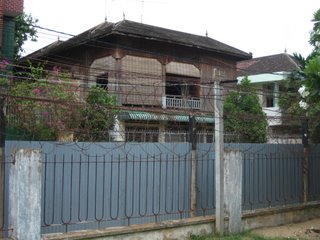
The view across the lane
After having our fill of luxury food, we slowly crossed the lane to the high double wall topped with several coils of barbed wire: genocide horror site 1. In 1975, Tuol Suay Prey High School was taken over by the Khmer Rouge killing machine and became the S-21 security prison. In S-21, people were detained for such things as having an education to high school level, or wearing spectacles. They were imprisoned and exterminated for being peasants, workers, engineers, teachers, doctors, students, Buddhist monks, ministers, Pol Pot's cadres, soldiers of all ranks, foreigners, and all their wives and children. By early 1977 it was claiming 160 victims per day; these 'lucky' ones were buried on site in mass graves. Most detainees however ended up in the nearby Cheoung Ek Extermination Camp: 'The Killing Fields'.
Each of Building 1's classrooms contained only a metal bedframe (no mattress), a bullets can/toilet and a wall-mounted photo of the room as it was found, including the bird-pecked corpse of the ex-government official who died trussed to the bed in each cell:
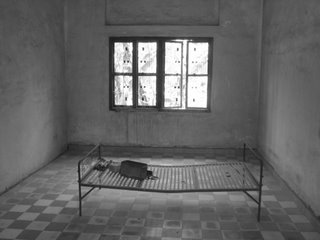
A classroom/prison cell
Outside in the yard is a billboard listing the rules and regulations that had to be adhered to by the detainees, and the punishments if they weren't:
1. You must answer accordingly to my question - Don't turn them away.
2. Don't try to hide the facts by making pretexts this and that. You are strictly prohibited to contest me.
3. Don't be a fool for you are a chap who dare thwart the revolution.
4. You must answer immediately my questions without wasting time to reflect.
5. Don't tell me either about your immoralities or the essence of the revolution.
6. While getting lashes or electrification you must not cry at all.
7. Do nothing, sit still and wait for my orders. If there is no order, keep quiet.
8. Don't make pretext about Lampuchea Krom in order to hide your secret or traitor.
9. If you don't follow the above rules, you shall get many lashes of electric wire.
10. If you disobey any point of my regulations you shall get either 10 lashes or five shocks of electric discharge.
*Remember, these people were being detained simply for being peasants, workers, engineers, teachers, doctors, students, Buddhist monks, ministers, Pol Pot's cadres, soldiers of all ranks, foreigners, and all their wives and children.
Building 2's balcony corridors were sealed by barbed wire mesh to prevent detainees jumping to an easy death. Below it, the gym frame had been converted to gallows: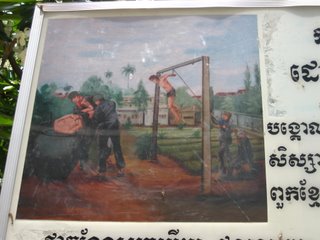
The gallows
"A pole with cables attached had been used for the students to conduct their exercise. The Khmer Rouge utilised this place as interrogation room. The interrogators tied both hands of the prisoners to the back by a rope and lifted the prisoners upside down. They did like this until the prisoners lost consciousness. Then they dipped the prisoner's head into a jar of smelly, filthy water, which they normally used as fertiliser for the crops on the terrace outside. By doing so, the victims quickly regain consciousness, and that the interrogators could continued their interrogation."
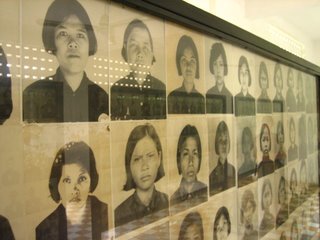
The long rooms inside Building 2 are filled with presentation boards, upon which hundreds of photos of sullen-faced and pained Cambodians are mounted. These males and females aged 8 to 80 were some of the Khmer Rouge soldiers and their victims, the soldiers only differentiated from their prey by not having a number tag around their necks:
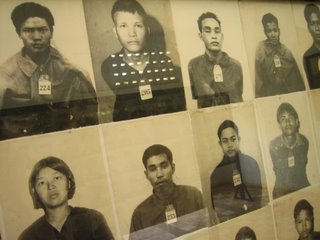
Victims
Khmer Rouge soldiers
Classrooms have been converted into galleries that exhibit photos and biographies of village youngsters (CHILDREN!) who'd entered the Khmer Rouge, what atrocities they'd personally committed and how they'd come to an early death at the hands of other Khmer Rouge soldiers.
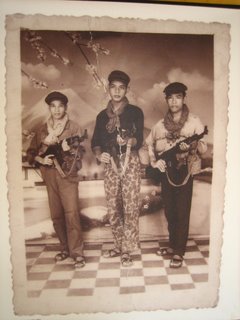
'noble heroes'!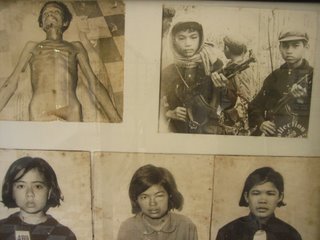
Child soldiers and their 'work'
One of the many examples is of Uy Ren, who was born in 1951 and joined the revolution at the age of 19:
"Ren was a simple woman, not so bad. She asked her parents' permission to join the Khmer Rouge because at that time, everyone was joining. It was better than staying in the village and carrying dirt. The female youth teams in our village were asked to carry dirt at Tuol Krasaing and they all disappeared.
Ren was sent to the battlefield near Tonle Mekong to fight. There were only females in her unit and they fought on the front lines. She was a group chief.
Ren first visited home quite a lot before the Khmer Rouge took control of Phnom Penh. She came looking for cows. In July 1977 she came home again to find food, this time in an army lorry. The others with her carried guns but she didn't; she only carried her gun in the battlefield. She stayed one night. She didn't say much.... After that she disappeared.
I kept her picture for the future in case she came back one day.... One person told me she died in the bombing at Srey Royong. Someone else said she was taken to Tuol Sleng [S-21]"
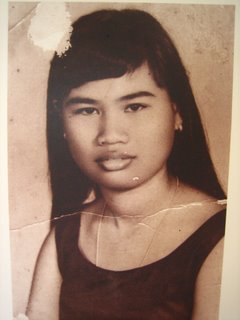
Ren, the "not so bad" girl
Other rooms were divided by brick partitions into torture cells the size of portaloo toilet cabins, containing only a bullet tin for a toilet and a leg-chain floor mount. Another storey was filled with graphic images of torture methods used and photos of people, when alive and dead, who'd succumbed to them. Building 3 contained photos of Khmer Rouge high officials that had been graffittied by Cambodian expletives.
I was too distressed to look at any more of the Khmer Rouge's work, so I looked at the graffiti on corridor walls. Some was drawn at the time the buildings were still Tuol Suay Prey High School: outlines of girls wearing stylish, brimmed bonnets, cars, a maths equation.
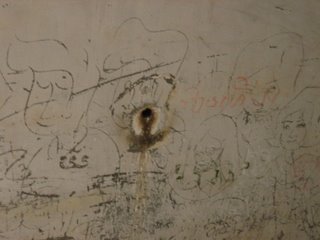
Schoolkid art
Other scrawlings were by tourists, and range from the poignant:
"When this was a prison no-one learned.
When this was a school no-one died"
through the ignorant and moronic:
"Jesus is the answer"
"Jesus reigns"
to some of dispicably bad taste, considering the setting:
"This is socialism? Go U.S.A"
"They hate us [U.S.A.] because they're jealous of us"
Of course, the last American opinions had provoked a spiderdiagram of responses by people as horrified as I to see such narrow-minded and disgraceful thoughts actually written. Did these idiots know the Khmer Rouge were armed and financed throughout the 1980's by China and the U.S. (indirectly through Thailand of course) (3)? Graffittied responses included mention of Abu Ghraib (The U.S.'s very own torture camp in Iraq), Thatcher's "You must understand. There are responsible members of Khmer Rouge", and:
"Are we supposed to be jealous of your [U.S.A.]: literacy, poverty, violent death rate, pollution, racism, trash culture, imperialism, ignorance, obesity?"
What a pity pro- and Anti-U.S.A. slanging matches are even being set onto stone in a former torture centre.
Of course, S-21 wasn't the only security prison of it's kind in Cambodia, as this key of a regional death map shows (Genocide memorial - 77; Security office (Prison) - 167; Killing sites - 343; mass graves - 19440):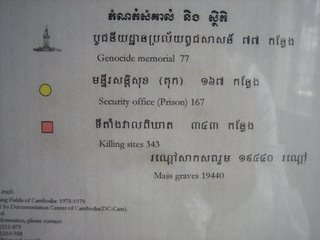
How many?
Sickened deep into the gut by the horrors of Tuol Suay Prey High School/S-21 security prison, Andy and I then took a motorbike taxi (3 men squeezed on one 100cc motorbike and 1 helmet between us - the norm) along the route taken by the S-21 survivors, to their final resting place....
(1) http://news.nationalgeographic.com/news/2005/12/1202_051202_cambodia.html
(3) Southeast Asia on a shoestring. Lonely planet, 2004.
posted by Graham, Manchester at 11:43 am


<< Home